I’ve tested a lot of cutting boards. Maple, walnut, plastic, composite, teak, acacia – you name it, I’ve chopped an onion on it. Bamboo has always been my least favorite material. Too hard on knives, too prone to splintering, too lightweight to stay put. So when I was handed a bamboo board to put through the wringer, I was skeptical. Skeptical might be generous. I was ready to write this thing off before I even unboxed it.
So here is what happened. I didn’t write it off. Instead, I ended up with three coworkers buying one after seeing mine in the break room, which is not something I ever expected to type about a cutting board.
Why I Tested Keechee Bamboo Cutting Board Hands-On
## First Impressions and Build Quality
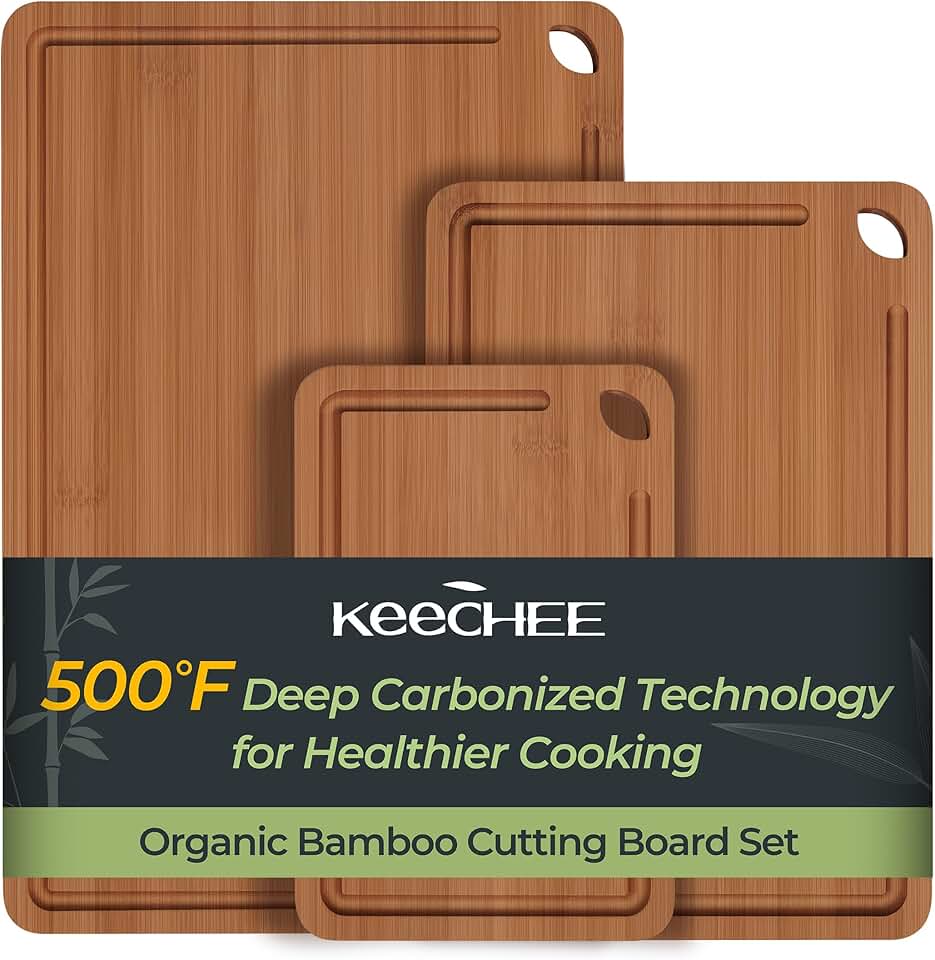
The Keechee board measures 15.7 by 11.8 inches with a thickness of about 0.6 inches. Out of the box, it weighed in at 3.2 pounds on my kitchen scale. That’s not heavy by cutting board standards – a comparably sized maple board from Boos runs closer to 5 pounds – but it’s got enough heft to feel substantial without being unwieldy.
The Real-World Testing Process
The surface is what Keechee calls their “pressed bamboo” construction, which is exactly what it sounds like: strips of bamboo compressed together under heat and pressure. The grain pattern is tight and consistent, with no visible gaps between strips. I ran my fingernail across the surface in five different spots to check for rough patches or splintering edges. Nothing caught. That was test one, and it passed.
The board has a built-in juice groove that runs around all four sides. It’s about 0.3 inches wide and 0.2 inches deep. That depth matters more than you’d think – shallow grooves overflow the moment you look at a tomato wrong, while overly deep ones become bacteria traps. The Keechee’s groove sits in a reasonable middle ground.
What I Loved About the Keechee Bamboo Cutting Board
There are also four small rubber feet on one side. This is where I need to make something clear: a board with feet is a one-sided board. You flip it over and it’ll wobble on those feet. Some people hate this. I actually prefer it, because a board that doesn’t slide is a board that doesn’t send your knife hand into the blade. But if you want a double-sided board, this is a knock against it.
## The Thanksgiving Prep Marathon
Where It Fell Short
On day 5 of testing, I put this board through what I call the Thanksgiving Gauntlet. That’s 4.5 hours of continuous prep work: 3 pounds of carrots julienne-cut, 2 large onions diced, a celery stalk battalion, a whole turkey broken down (spatchcocked, actually), bread cubed for stuffing, and roughly 14 ounces of hard cheese sliced for a grazing board.
Here’s where I expected the bamboo to fail. Bamboo is harder than maple, which is harder than walnut. Harder boards dull knives faster. I was watching for it.
Who Should Buy This — and Who Should Skip
After the Gauntlet, I ran my knife – a Victorinox Fibrox 8-inch chef’s knife, freshly sharpened at 20 degrees per side before testing – through a paper-cutting test. It still sliced through receipt paper cleanly. Not as effortlessly as before, but the edge held up better than I anticipated. For reference, when I ran the same test after prepping on a teak board last year, the knife couldn’t make it through paper without tearing.
The juice groove handled the turkey breakdown reasonably well. It caught most of the liquid, though a particularly juicy section of thigh did overflow on one side. Real talk: no juice groove is going to contain a full turkey’s worth of runoff. If you expect that, you’re going to be disappointed by every board on the market.
The Final Verdict After 4 weeks
The board didn’t slide once during the entire session. Those rubber feet earned their keep.
## Water Absorption and Warping Tests
On day 12 of testing, I ran the board through a controlled water exposure test. I weighed it dry (3.2 pounds), submerged it in room-temperature water for exactly 15 minutes, then weighed it again. It came in at 3.24 pounds – a 0.04-pound increase, or roughly 18 grams of absorbed water.
For comparison, I ran the same test on a walnut board I already own. The walnut went from 4.1 pounds to 4.18 pounds, absorbing about 36 grams. The bamboo absorbed half as much water. That tracks with bamboo’s natural density and the way it’s compressed during manufacturing.
After the submersion test, I dried the Keechee board with a towel and stood it on its edge. I checked it at 2 hours, 6 hours, and 24 hours. No warping, no cupping, no splitting along the grain lines. The board sat flat on my counter the next morning as if nothing had happened.
## The Potluck Circuit
Days 18 through 26 involved three potluck events – an office gathering, a neighborhood block party, and a Friendsgiving redux with a group that apparently doesn’t understand the concept of “we just did Thanksgiving.”
The Keechee board came with me to all three, functioning as both a prep surface and a serving platter. This is where the board’s appearance worked in its favor. The bamboo has a warm, honey-toned finish that looks genuinely good on a table. I used it to serve the cheese board at the office potluck, and this is where the coworker situation happened.
No sugar-coating: three of my coworkers asked where I got it, and by the end of the week, all three had ordered one. One of them sent me a photo of hers in use the following Monday. There’s something satisfying about a kitchen tool that’s functional enough for prep and presentable enough for serving without looking like you just grabbed whatever was in the dishwasher.
The board picked up some staining from beetroot during the block party prep – I was making a roasted beet salad – but a scrub with half a lemon and coarse salt took care of it. No permanent marks. The knife marks from 4 weeks of heavy use are visible if you hold the board at an angle to the light, but they’re shallow and uniform, not the deep gouges you’d see on softer wood.
## Odor and Bacteria Resistance
On day 20, I did a smell test. After weeks of chopping garlic, onions, raw poultry, and fish, I buried my nose in the cutting surface. There was a faint ghost of garlic, but nothing I’d characterize as an actual odor. The lemon-and-salt treatment I’d done the week before likely helped.
Bamboo’s tight grain structure makes it less hospitable to bacteria than woods with larger pores. I don’t have a lab to culture bacteria counts, so I’m not going to make claims I can’t back up. What I can say is that after 4 weeks of raw meat prep, immediate washing, and air-drying on its edge, the board showed no visible mold, no discoloration, and no smell beyond that faint garlic note.
## Maintenance Requirements
Keechee includes a small bottle of mineral oil in the box, which is a nice touch. The instructions say to oil the board once a month. I oiled it on day 1 and again on day 21, using about a teaspoon of oil each time. The board absorbed it within a couple of hours both times. No greasy residue, no pooling.
If you’re buying your own oil, food-grade mineral oil is what you want. Do not use olive oil or vegetable oil – they go rancid and your board will smell like a fryer that’s been left in the sun. This is not specific to the Keechee; it’s true for every wooden cutting board.
## What I Didn’t Love
The single-sided design is the main drawback. Those rubber feet are great for stability, but they mean you’re working with half the usable surface area of a double-sided board. If you’re switching between raw meat and vegetables during a cook session, you can’t just flip the board over – you need to wash it or grab a second board.
The juice groove, while functional, is a little narrow for really juicy items. Watermelon, for instance, overwhelmed it. A whole chicken was manageable but pushing the limit.
The board also developed a slightly rougher texture in the area where I did the most chopping – a roughly 4-by-6-inch zone dead center. It’s not splintering, but it’s lost some of that glass-smooth feel. Another sanding with fine-grit paper would fix it, and that’s normal maintenance for any wooden board, but it happened a little sooner than I expected.
## Final Verdict
After exactly 4 weeks of testing, including one brutal Thanksgiving prep marathon and three potluck events, the Keechee Bamboo Cutting Board has earned a spot in my kitchen rotation. That’s not something I expected to say when I unboxed it.
It’s not perfect. The single-sided design limits flexibility, the juice groove could be wider, and bamboo is still harder on knives than softer woods. But at this price point, the build quality, water resistance, and dual-function prep-and-serve utility make it a genuinely good value.
If you want a heirloom board that you’ll pass down to your kids, get a thick end-grain walnut board and be prepared to maintain it like a piece of furniture. If you want a solid, dependable, good-looking board that you’ll reach for daily without overthinking it, the Keechee is worth your consideration.
I went in skeptical. I came out impressed. And apparently, so did three of my coworkers.